Architect Fee in Pakistan 2026 — What You’ll Actually Pay (Complete Price Guide)

You ask five architects in Pakistan what they charge.
You ask five architects in Pakistan what they charge. You get five completely different answers.
One quotes Rs. 50,000 for a complete 10 Marla design. Another says Rs. 2,50,000 for the same plot. A third offers “free drawings” if you use their contractor. A fourth gives you a rate per square foot. The fifth wants a percentage of your construction budget.
All five are architects. None of them is lying. They’re just speaking completely different languages — and if you don’t know which language is which, you have no way to compare what you’re actually being offered.
There is no government-published rate card for architect fees in Pakistan. The Pakistan Council of Architects and Town Planners (PCATP) has internal fee guidelines, but these are not widely communicated to clients, and the open market operates independently of them.
What you actually pay depends on who you hire, what scope you agree to, where your plot is located, and which governing authority — CDA, RDA, DHA, or LDA — controls your area.
This guide cuts through all of that. You’ll know exactly what each fee model means, what real 2026 prices look like by plot size and city, what’s typically included in a proposal (and what isn’t), and how to protect yourself from the most common traps.
The first thing to understand is that the absence of a standard rate isn’t a flaw — it’s a reflection of how professional services work. The architecture design service has a scope, complexity, and regulatory requirements that vary dramatically from one project to the next.

Pakistan’s market has three specific factors that make the confusion worse than it needs to be:
First, most clients don’t know the difference between a licensed PCATP-registered architect, a draftsman (locally called a naqsha nawees), and a civil engineer. All three can produce building drawings. Only one is legally authorized to sign those drawings for CDA, RDA, or LDA submission.
Second, four completely different fee structures are operating simultaneously in the market, and architects don’t always disclose upfront which one they’re using or why.
Third, the word “design” means different things to different firms. One firm’s Rs. 80,000 “design” includes structural drawings, MEP schematics, 3D renders, and CDA submission. Another firm’s Rs. 80,000 “design” is a floor plan and two elevations. Both will hand you a drawing set and call it complete.
Before any price comparison is meaningful, you need to understand the fee models — and the scope each quote is actually covering.
| Professional | Can Design Your Home | Can Sign CDA Drawings | Fee Range (PKR) |
|---|---|---|---|
| PCATP-Registered Architect | Yes | Yes (all sheets) | 50,000 – Rs. 7,00,000+ |
| Draftsman / Naqsha Nawees | Basic plans only | No | 10,000 – Rs. 50,000 |
| Civil / Structural Engineer | Structural sheets | Structural sheets only | 20,000 – Rs. 80,000+ |
For Islamabad clients, CDA requires that residential building drawings be signed and stamped by a PCATP-registered architect. Submissions bearing only a draftsman’s signature are rejected at the counter — and you’ll pay twice: once for the draftsman, and once for the architect you should have hired first.
Architects in Pakistan typically charge clients using one of four fee structures:
The oldest and most internationally standardized method. The architect charges a percentage of the total project construction budget — typically ranging from 2% to 5% for residential projects in Pakistan, and up to 7–8% for high-complexity commercial or institutional work.
Who uses it: established architecture firms on larger residential projects (1 Kanal and above) and commercial developments where the construction budget is defined upfront.
For example:
| Project | Construction Budget (PKR) | Architect Fee at 3% (PKR) |
|---|---|---|
| 5 Marla, Single Storey | 60,00,000 | 1,80,000 |
| 10 Marla, Double Storey | 1,20,00,000 | 3,60,000 |
| 1 Kanal, Triple Storey | 2,50,00,000 | 7,50,000 |
What to watch:
Each interpretation produces a different number — and a different fee at completion.
The majority of residential architects in Pakistan price by covered area — the total built-up area across all floors. In 2026, rates typically range from Rs. 15 to Rs. 60 per square foot, with the spread reflecting differences in scope tier and the architect’s experience level.
Covered area vs. plot area:
A 10 Marla plot (225 square yards of land) will typically yield 2,200–2,600 sq ft of covered (built) area across two floors. The architect’s per-square-foot rate is applied to the covered area, not the plot size.
For example:
| Tier | Rate Range (PKR) | Scope Included |
|---|---|---|
| Entry (draftsman-level) | 10–20/sq ft | Basic floor plans + 2 elevations |
| Standard (registered architect) | 25–45/sq ft | Full drawing set, basic 3D |
| Premium (senior firm/principal) | 50–80/sq ft | Full service + detailed renders + supervision |
Pakistan-based architecture firms offer bundled fixed-price packages for standard residential plots. The package defines a specific set of deliverables — floor plans, elevations, sections, approval drawings — at a single, all-in price.
When it works well: the project scope is clearly defined, the plot is standard, and the client wants cost certainty upfront.
A “fixed fee” without a written, itemized scope document is effectively an unlimited scope. Every change, additional sheet, or revision beyond an unstated limit becomes a renegotiation.
What to always request: a written scope document listing exactly what’s included before any deposit changes hands. If the architect won’t provide this, the “fixed” fee is not fixed at all.
Some architects charge by the hour for advisory services — feasibility assessments, second opinions on another firm’s drawings, CDA dispute support, or renovation consultations.
2026 Rates in Islamabad:
| Seniority Level | Hourly Rate (PKR) |
|---|---|
| Junior Architect / Draftsman | 3,000–5,000 |
| Mid-Level Registered Architect | 6,000–10,000 |
| Senior Architect / Principal | 12,000–20,000 |
If you’ve received drawings from another firm and want an expert review before CDA submission, a paid consultation hour is often the most cost-efficient option available.
The 2026 market rates vary for registered architects across Pakistan. Islamabad-specific rates trend toward the upper end due to CDA regulatory complexity and DHA/Bahria Town overlay requirements.
| Plot Size | Design Only (PKR) | Full Service (Design + 3D + Approvals) | Full Service + Supervision |
|---|---|---|---|
| 5 Marla | 50,000–80,000 | PKR 80,000–1,40,000 | PKR 1,20,000–1,90,000 |
| 7 Marla | 70,000–100,000 | PKR 100,000-1,50.000 | PKR 1,50,000–2,50,000+ |
| 10 Marla | 80,000–1,50,000 | PKR 1,40,000–2,50,000 | PKR 2,00,000–3,50,000 |
| 1 Kanal | 1,50,000–2,50,000 | PKR 2,50,000–4,50,000 | PKR 3,50,000–6,00,000 |
| 2 Kanal | 2,50,000–4,00,000 | PKR 4,00,000–7,00,000 | PKR 5,50,000–9,00,000 |
| Deliverable | Design Only | Full Service | Full Service + Supervision |
|---|---|---|---|
| All floor plans | ✔ | ✔ | ✔ |
| Exterior elevations (all sides) | ✔ | ✔ | ✔ |
| Site plan / boundary layout | ✔ | ✔ | ✔ |
| Section drawings | ✔ | ✔ | ✔ |
| 3D exterior rendering | ✖ | ✔ | ✔ |
| 3D interior walkthrough | ✖ | Depends | ✔ |
| Structural / RCC drawings | ✖ | ✔ | ✔ |
| MEP / plumbing schematics | ✖ | ✔ | ✔ |
| CDA / society approval submission | ✖ | ✔ | ✔ |
| Scheduled site supervision visits | ✖ | ✖ | ✔ |
| Project Type | Design Only (PKR) | Full Service (PKR) | With Supervision (PKR) |
|---|---|---|---|
| Small Office (up to 3,000 sq ft) | 1,50,000–2,50,000 | 2,50,000–4,00,000 | 4,00,000–6,50,000 |
| Retail / Plaza | 2,00,000–3,50,000 | 3,50,000–6,00,000 | 5,50,000–9,00,000 |
| Mixed-Use Building | 3,00,000–5,00,000 | 5,00,000–9,00,000 | 8,00,000–14,00,000 |
| Hotel / Hospitality | 4,00,000–7,00,000 | 7,00,000–14,00,000 | Quoted separately |
Plots in DHA Islamabad (Phase 1–6) and Bahria Town Islamabad require additional submission documentation. Documents include society-specific NOC applications, drawing format compliance with society guidelines, and rainwater harvesting system drawings.
These requirements add to the architect’s workload and are reflected in higher fees for these localities.
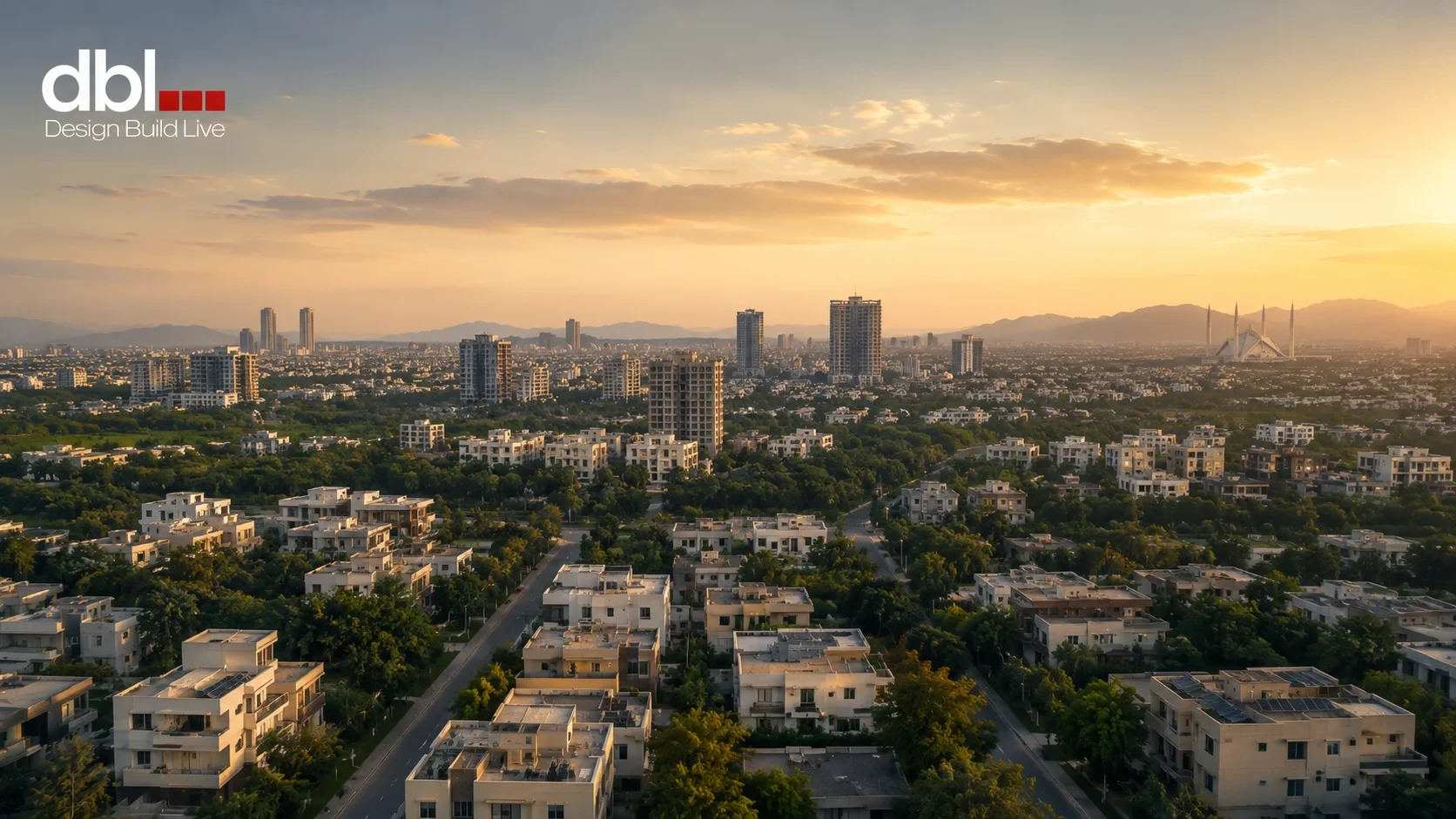
Islamabad commands the highest architect fees in Pakistan for a specific and justified reason: CDA is the most documentation-intensive building authority in the country.
A single rejected submission triggers redrawn drawings, a new inspection cycle, additional authority fees, and weeks of delay. Architects with active CDA experience — including up-to-date knowledge of 2026 regulatory changes — provide measurable risk reduction, and their fees reflect that.
Rawalpindi operates under the Rawalpindi Development Authority (RDA), which has a less complex submission process than CDA. Fees are typically 15–25% lower than equivalent Islamabad projects.
Key areas: Gulrez Housing Scheme, Askari Phases, Bahria Town Phases, Royal Orchard, and DHA Rawalpindi.
LDA governs core Lahore; DHA Lahore operates as a parallel authority. The breadth of competition produces the widest price range of any Pakistani city:
SBCA (Sindh Building Control Authority) and KDA operate in parallel in Karachi, creating a submission complexity similar to Islamabad. Commercial architecture fees are highest here in absolute terms, driven by the density of large-scale commercial work.
Lower absolute fees but a thinner pool of PCATP-registered practitioners. For clients in these cities building larger or more complex projects, hiring a remotely-based Islamabad or Lahore firm is increasingly practical.
Yes — and it is now more viable than at any previous point. The best architects in Islamabad serve clients across Pakistan digitally:
Overseas Pakistani clients building anywhere in the country use this model regularly. The only service that genuinely requires physical presence is site supervision.
This is where most client-architect disputes begin. The following are typical market practices across Pakistan’s residential architecture sector in 2026.
| Deliverable | Usually Included? | If Extra — Typical Cost (PKR) | Negotiable? |
|---|---|---|---|
| Floor plans (all levels) | Always | — | — |
| Exterior elevations (all four sides) | Always | — | — |
| Site plan/boundary layout | Usually | — | — |
| Section drawings | Usually | — | — |
| 3D exterior rendering (basic) | Sometimes | 15,000–35,000 | Yes |
| 3D interior walkthrough/animation | Rarely | 30,000–80,000 | Yes |
| Structural / RCC drawings | Depends on the package | 35,000–120,000 | Sometimes |
| MEP (electrical, plumbing, drainage) | Rarely | 25,000–100,000 | Yes |
| CDA / RDA / society submission service | Depends | 30,000–80,000 | Yes |
| Revision rounds beyond the included quota | No | 5,000–20,000/round | Yes |
| Site supervision (per visit, unbundled) | No | 3,000–8,000/visit | Yes |
| Rainwater harvesting drawings (CDA 2026) | Depends | 10,000–35,000 | Yes |
Most important question to ask any architect before signing:
Is structural drawing work included in the scope, and who prepares the MEP schematics?
If the answer to either is vague, treat those items as exclusions and budget accordingly.
Government authority fees are entirely separate from the architect’s professional fee, and for larger plots in Islamabad, they can exceed the architect’s fee.
CDA’s building permit fee is calculated on the covered area and the zone of your plot, with rates updated periodically.
Average CDA Approval Costs (Roughly Estimated):
In 2026, CDA now mandates rainwater harvesting system drawings as a compulsory component of every new residential building permit application. If your architect’s quoted scope was drafted before this requirement, confirm explicitly whether these drawings are included.
DHA operates its own planning department. A DHA NOC is required before any construction can begin on a DHA-registered plot. NOC fees are calculated on plot size for residential projects.
The current 2026 baseline map approval rates are roughly:
DHA also maintains its own drawing format requirements, which must be followed in addition to CDA compliance.
Bahria Town’s design guidelines are among the most prescriptive in Pakistan. Every elevation treatment, boundary wall height, material finish, and colour specification may be subject to society review. Internal Bahria Town approval fees apply on top of CDA requirements.
RDA’s building permit fees are generally lower than CDA’s.
The estimated total official RDA challan fee for architecture approval is:
Always request a written proposal that lists the architect’s professional fee and government authority charges as separate line items.
Understanding what drives the quote allows you to evaluate proposals fairly — and negotiate intelligently.
More covered area means more drawing sheets, more coordination rounds, and more detailed review. A triple-storey structure on the same 10 Marla plot costs significantly more to design than a single-storey equivalent.
CDA, DHA, Bahria Town, RDA, LDA, and SBCA each have different submission requirements, different drawing format standards, and different approval cycles. CDA’s multi-document package — especially with 2026 additions — adds more workload per project than a standard LDA submission.
A rectangular house on a flat rectangular plot is structurally and architecturally straightforward. Add a basement, a double-height living void, curved or angled walls, cantilever elements, or a rooftop structure, and the drawing complexity, structural engineering requirements, and fee increase proportionally.
A PCATP-registered architect with 15 years of CDA submissions commands a higher fee than a junior draftsman. That premium is justified when your authority has strict compliance requirements or your project has significant construction value.
Design-only, full-service, and full-service-plus-supervision are essentially three different products with three different fee levels. Comparing them on price alone, without accounting for scope, is a false comparison.
Standard residential design timelines of 4–8 weeks allow efficient, non-rushed work. Urgent timelines (under 3 weeks) almost always carry a rush premium of 20–40% because the architect has to reorganize their workload to prioritize your project.
Hidden costs are real costs that appear on invoices after the design contract is signed. This includes:
Negotiating on price alone is almost always the wrong strategy. These approaches produce better value without compromising scope or quality.
Understand exactly what’s in the proposed package before asking for a discount. A fully scoped engagement at Rs. 2,00,000 is a better value than a vague one at Rs. 1,20,000.
The more specific your requirements at the outset — exact room list, ceiling heights, style references, structural requirements — the fewer revision rounds you’ll need. Every avoided revision is time and money saved.
Most firms offer a lower bundled rate for design + 3D rendering + supervision than if each service is commissioned separately. Ask for a bundled quote explicitly.
If you’re not working toward a hard deadline, say so. Rush premiums of 20–40% are real. A 6-week design window is almost always cheaper than a 2-week one.
Draft your own scope description — using this guide — and send it to all three firms. Only when the scope is identical do the prices become genuinely comparable.
Milestone-linked payments keep the architect accountable and protect you if deliverables are delayed or incomplete. Standard milestones: deposit at signing, payment at concept approval, payment at drawing set completion, final payment at approval receipt.
DBL (Design Build Live) is an Islamabad-based full-service architecture and construction firm operating across CDA sectors, DHA Islamabad, Bahria Town, and Rawalpindi. Since our founding, we have structured every client engagement around one principle: no invoice should come as a surprise.
Every DBL project begins with a written, itemized proposal that separately lists:
Our full-service engagements bring the architect, structural engineer, and MEP consultant under a single coordinated contract — so there is no gap between what the architect designs and what the engineer specifies. The coordination problem is solved before it begins.
We serve Islamabad homeowners, developers, and overseas Pakistani clients building remotely. Digital consultations, shared 3D walkthroughs, and remote approval document management are standard for all out-of-city clients.
Book a free consultation with DBL. We’ll assess your plot, identify your governing authority’s specific 2026 requirements, and provide a fully itemized, no-surprise fee proposal for your Islamabad or Rawalpindi project.
For a 10 Marla residential house, architect fees in Pakistan in 2026 range from Rs. 80,000 to Rs. 3,50,000, depending on the service level. While the design-only package and full-service package costs vary in different cities of Pakistan
For a standard 10 Marla residential house, the design process from brief to completed approval drawing set typically takes 4–8 weeks. This includes one to two concept review rounds and the final detailed drawing production.
Yes. DBL currently serves clients across Islamabad, DHA, Bahria Town, and Rawalpindi, as well as overseas Pakistani clients building remotely. Video consultations, digital design reviews, 3D walkthroughs, and digital approval documentation packages make the design process fully manageable at a distance.
Yes—especially if you want to maximize space, avoid costly construction mistakes, and ensure proper ventilation, lighting, and structural planning. For a 5 Marla house, a skilled architect can often save more money through efficient design and reduced rework than their fee costs.
In most Pakistani residential architecture packages, structural drawings are included. DBL provides both architectural and structural design under one package, so you may not need to hire a separate engineer.