Residential Construction in Pakistan: Build a Custom Home in Islamabad & Rawalpindi (2026 Guide)
Residential construction in Pakistan has entered a sharper, more regulated, and more design-driven phase in 2026.
Residential construction in Pakistan has entered a sharper, more regulated, and more design-driven phase in 2026. Rising material prices, stricter Capital Development Authority (CDA) rules, and a growing appetite for custom villas have pushed homeowners to plan smarter, compare contractors carefully, and demand transparent costing.
This guide breaks down current per-square-foot rates, the end-to-end build process, CDA map approval requirements, and a clear framework for picking home construction companies in Islamabad and Rawalpindi.
Residential construction refers to the design, engineering, and physical building of homes. It includes independent houses, custom villas, duplexes, and small apartment blocks built on private plots.
A modern Pakistani residential project typically combines four core workstreams:
Custom home builders in Pakistan now bundle these workstreams into a single turnkey contract, so the homeowner signs once and receives the completed house on a fixed timeline.
Villa construction, in particular, has shifted toward smart-home wiring, double-glazed windows, and energy-efficient roofing as standard inclusions rather than luxury add-ons.
Construction costs in Pakistan rose steadily through 2024 and 2025, driven by cement, steel, and labour inflation. The average construction rate in 2026 ranges from PKR 2,800 to 3,500 per sq ft for a grey structure and PKR 5,800 to 8,800 per sq ft for a full turnkey project. Premium villa construction can push the turnkey figure significantly higher.
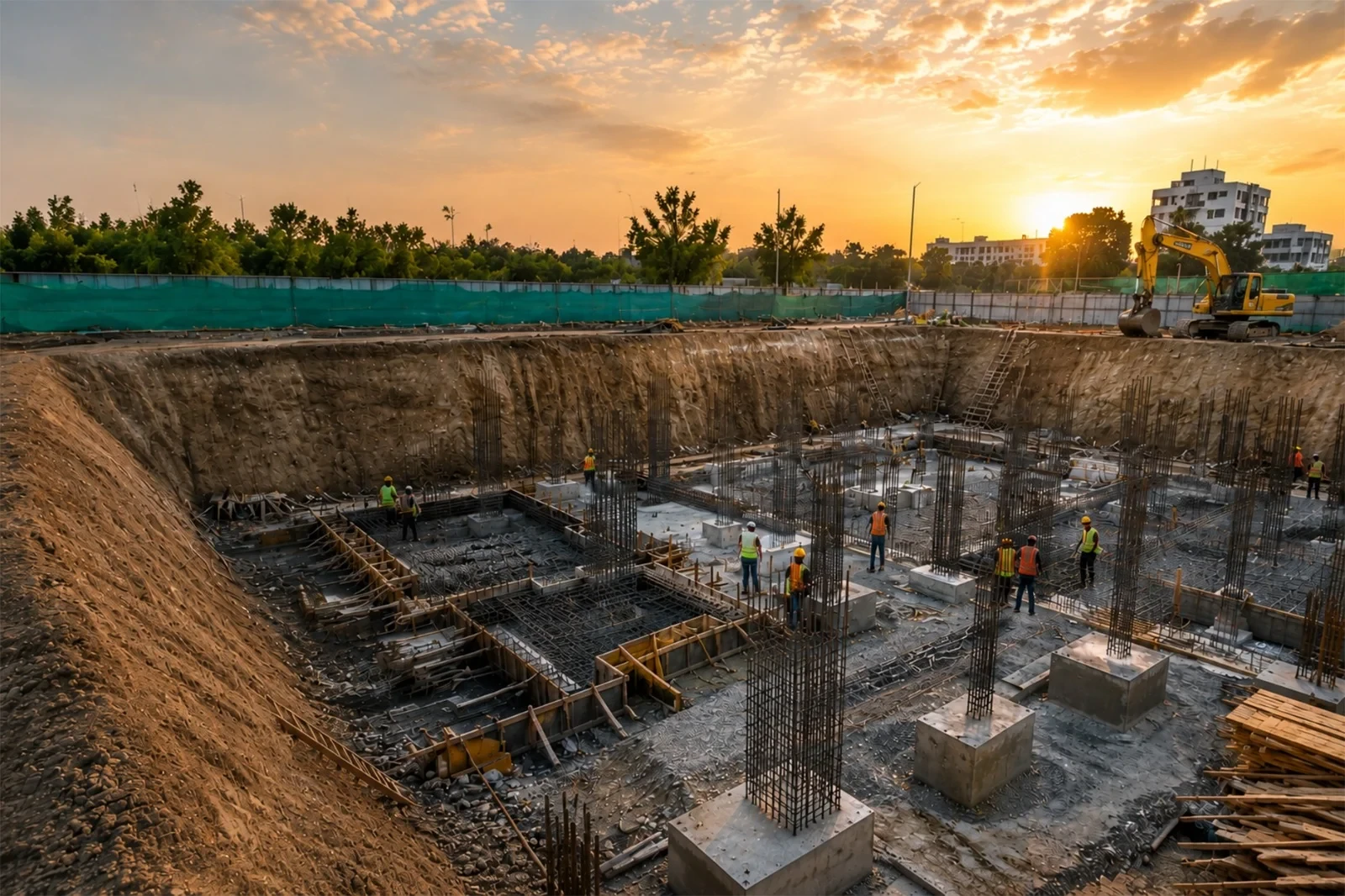
The grey structure is the load-bearing skeleton — foundation, columns, beams, slabs, brickwork, and roughed-in plumbing and electrical conduits — completed before any finishing begins.
Grey structure typically absorbs 55–65% of the total residential construction budget in Pakistan, which makes the grey structure per-square-foot rate the single most important number a homeowner negotiates.
| Zone | Standard | Premium (A+) | Luxury / DHA Tier |
|---|---|---|---|
| Islamabad (CDA Sectors) | PKR 2,800 – 3,400 | PKR 3,500 – 4,200 | PKR 4,300 – 5,000+ |
| Rawalpindi | PKR 2,650 – 3,200 | PKR 3,400 – 3,800 | PKR 4,000 – 4,700+ |
| DHA Islamabad / Margalla Enclave | PKR 3,200 – 3,800 | PKR 3,900 – 4,500 | PKR 4,600 – 5,200+ |
| Bahria Town Rawalpindi | PKR 2,900 – 3,500 | PKR 3,600 – 4,300 | PKR 4,400 – 5,000+ |
| Gulberg Greens / Park Enclave | PKR 3,000 – 3,600 | PKR 3,700 – 4,400 | PKR 4,500 – 5,100+ |
| Lahore (DHA / Bahria) | PKR 2,700 – 3,450 | PKR 3,500 – 4,200 | PKR 4,300 – 5,000+ |
Many factors consistently move the per-square-foot rate upward, and homeowners should ask the contractor to itemise each one in the BOQ.
Turnkey covers grey structure plus full finishing — flooring, paint, kitchens, sanitary fittings, woodwork, electrical fixtures, and final cleaning.
Turnkey construction cost in Pakistan ranges from PKR 5,800 to PKR 8,800 per sq ft for standard A-category homes, while luxury turnkey projects with imported finishes, smart-home systems, and HVAC routinely run PKR 10,000 to PKR 15,000+ per sq ft.
| Zone | Standard (A-Category) | Premium (A+) | Luxury / DHA Tier |
|---|---|---|---|
| Islamabad (CDA Sectors) | PKR 7,000 – 8,200 | PKR 8,500 – 10,500 | PKR 11,000 – 15,000+ |
| Rawalpindi | PKR 6,200 – 7,500 | PKR 7,800 – 9,500 | PKR 10,000 – 12,500+ |
| DHA Islamabad / Margalla Enclave | PKR 7,800 – 9,200 | PKR 9,500 – 11,500 | PKR 12,000 – 16,000+ |
| Bahria Town Rawalpindi | PKR 6,800 – 8,000 | PKR 8,300 – 10,000 | PKR 10,500 – 13,500+ |
| Gulberg Greens / Park Enclave | PKR 7,200 – 8,500 | PKR 8,800 – 11,000 | PKR 11,500 – 14,500+ |
| Lahore (DHA / Bahria) | PKR 6,500 – 8,500 | PKR 9,000 – 11,000 | PKR 11,500 – 14,000+ |
Real quotes vary with soil, basement, elevation complexity, and finish brand selection. Below summarises planning ranges for Islamabad and Rawalpindi in 2026:
| Plot Size | Typical Covered Area | Grey Structure (PKR) | Turnkey Standard (PKR) | Turnkey Premium (PKR) |
|---|---|---|---|---|
| 5 Marla | ~1,900 sq ft | 55 – 70 Lacs | 1.3 – 1.7 Crore | 1.9 Crore+ |
| 7 Marla | ~2,800 – 3,000 sq ft | 80 Lacs – 1 Crore | 1.8 – 2.5 Crore | 2.7 Crore+ |
| 10 Marla | ~3,000 – 3,300 sq ft | 95 Lacs – 1.2 Crore | 2.2 – 2.8 Crore | 3.2 Crore+ |
| 1 Kanal | ~4,500 – 5,000 sq ft | 1.4 – 1.8 Crore | 3.5 – 4.5 Crore | 6 – 8 Crore+ |
A 1 Kanal house in Islamabad is typically completed in 6–8+ Crores when basement construction is included, since basement work adds excavation, RCC, waterproofing, and ventilation costs.
A typical residential build in Islamabad allocates costs roughly as follows:
Skipping the contingency reserve is the single most common budgeting mistake among first-time homeowners in Pakistan.
Custom home builders in Islamabad follow a structured workflow. Homeowners should ask every contractor for a written schedule that maps to these stages.
A standard 10 Marla home in Islamabad usually completes in 10–14 months; a 1 Kanal villa with a basement and premium finishing runs 14–20 months.
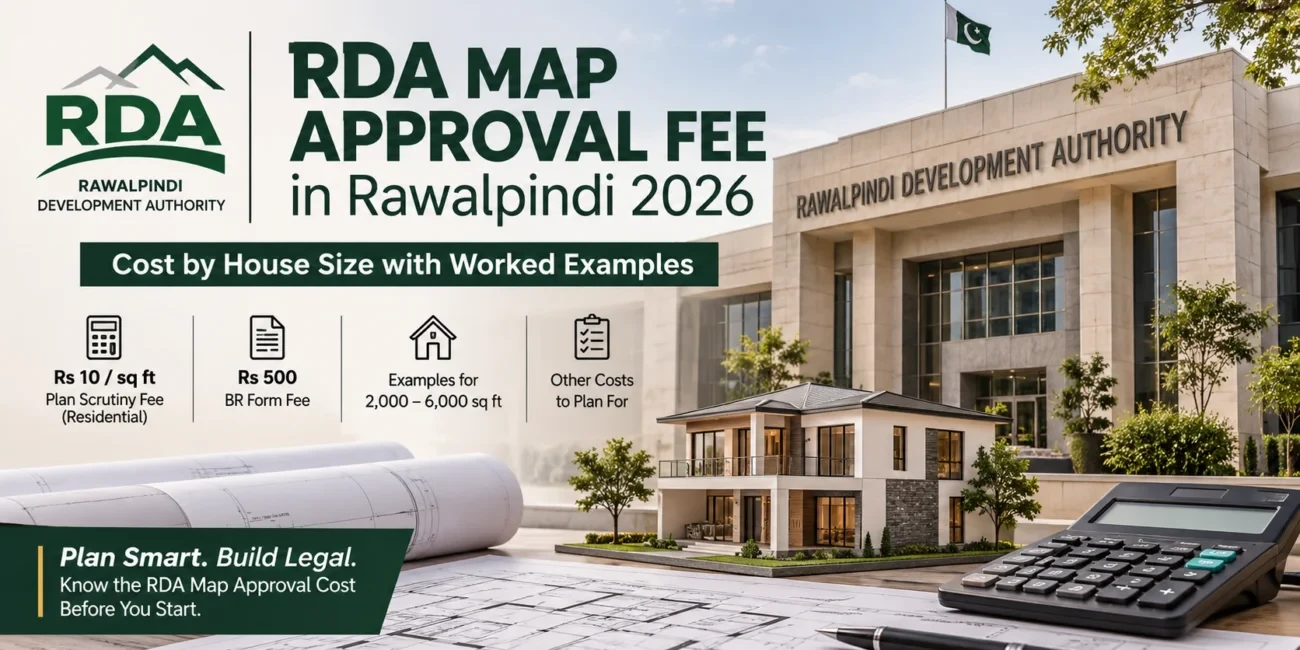
No legal residential construction in Islamabad begins without an approved building plan. The CDA’s Building Control Section vets every submission against the master plan of the relevant sector.
Homeowners must submit a Submission File that includes Form A1 and A2, along with six sets of the “Technical Trio” — Architectural, Structural, and Services drawings — which the CDA’s Building Control Section vets against the master plan of the specific sector.
The biggest regulatory shift in 2026 affects every new home. Following a landmark directive issued on March 18, 2026, the CDA has made Rooftop Rainwater Harvesting compulsory for all new constructions in Islamabad. To get a map approved, the design must include a catchment and filtration plan for collecting rooftop water and passing it through a dedicated filtration pit.
In 2026, permanent gas and electricity connections are strictly withheld until a Completion Certificate is issued, and CDA penalties for building violations — including encroaching on setbacks or exceeding FAR — have been revised upward. Building first and seeking forgiveness later has become financially punishing.
Different societies operate their own building control bodies. Homeowners should match the approving authority to the plot location:
Most disputes between homeowners and contractors trace back to vague contracts and missing documentation. Use this checklist when shortlisting house construction companies in Islamabad.
Villa construction differs from standard residential builds in three measurable ways: structural complexity, MEP density, and finishing brand selection.
| Specification | Standard Home | Premium Villa |
|---|---|---|
| Cement grade | OPC 42.5 (local) | OPC 53 (local or imported) |
| Steel (rebar) | Grade 60 local | Grade 60 mill-test certified |
| Flooring | Local porcelain tiles | Imported marble / engineered wood |
| Kitchen | Local laminate | Imported acrylic/lacquer cabinets |
| HVAC | Split AC, ceiling fans | Central / VRF system, underfloor heating |
| Glazing | Single-pane aluminium | Double-glazed thermal-break uPVC |
| Smart systems | None / basic | Full home automation, CCTV, IP intercom |
| Façade | Plaster + paint | Stone cladding, ACP panels, feature lighting |
Premium villa construction in Islamabad’s high-end zones routinely uses imported sanitaryware (Grohe, Kohler, Hansgrohe), German kitchen hardware (Blum, Hettich), and energy-recovery ventilation systems — none of which appear in standard A-category quotes.
Location dictates more than land price; the location also determines material logistics, labour rates, and which building control authority approves the plan.
In Islamabad, construction rates run PKR 3,200 to 5,800 per square foot, with some areas in the capital exceeding PKR 6,000, while Rawalpindi offers slightly lower rates in some areas at PKR 2,600 to 4,200. Rawalpindi remains the more budget-friendly option for first-time builders without sacrificing build quality.
First-time homeowners repeatedly fall into the same five traps. Avoiding them protects 10–20% of the total budget.
Residential construction in Pakistan succeeds on two fronts — sharp architectural design and disciplined execution on site. Homeowners across Islamabad and Rawalpindi increasingly want one accountable partner who draws the plan, secures CDA approval, builds the structure, and hands over the keys.
DBL designs and builds your house under one roof. Our in-house architects produce the floor plan and 3D elevation, our structural engineers stamp the drawings, and our site teams deliver the grey structure and finishing on a fixed-price contract with a written milestone schedule.
Every DBL project includes:
Whether you are planning a 5 Marla starter home, a 10 Marla family residence, or a 1 Kanal luxury villa in DHA, Bahria Town, Gulberg Greens, or Park Enclave, DBL handles every stage from blueprint to keys.
Ready to build? Contact DBL today for a free site visit, transparent quote, and a custom design proposal — and move into a home built right the first time.
A standard 10 Marla double-storey home takes 10–14 months from foundation to handover, assuming approved drawings and no design changes mid-project.
Yes. CDA approval is now strictly enforced across all CDA sectors, and supplementary approvals apply in DHA, Bahria, and private societies.
5 Marla and 7 Marla plots offer the strongest cost-per-bedroom efficiency for first-time homeowners, while 10 Marla and 1 Kanal suit families seeking long-term family homes or villa construction.
DBL, as an established home construction company in Islamabad, offers turnkey contracts that bundle architecture, structure, MEP, finishing, and CDA approval support into one fixed-price agreement.
Yes. The March 2026 CDA directive applies to all new constructions regardless of plot size, and approvals are now withheld without a compliant rainwater harvesting plan.